
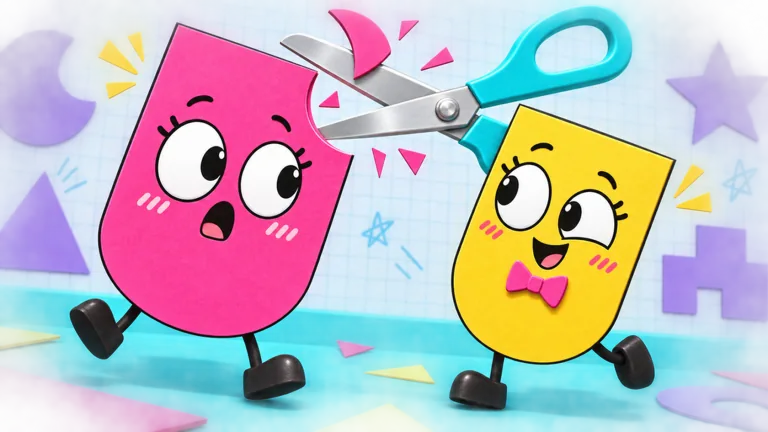
Keep the first curved piece for the next cut
Shape a curved piece, then use that changed character to shape the next teammate. Once the complementary pieces exist, rotate and position them together in the dotted ribbon target.
Here, a finished shape also becomes the cutting tool for the next piece. Reforming immediately after the first successful cut discards the boundary you still need.
Plan the first body for two jobs: filling its part of the final outline and providing a cutting edge for its partner.
Read the two pieces as a relationship
Inspect the target’s curves, angles and shared boundaries before cutting. Decide which piece you will build first and which partner will receive the next shape from it.
Plan pieces that fit together inside the dotted arrangement. Compare the boundary each piece contributes to the other instead of making identical bodies.
Rotate full characters into a rough target position before making changes. That helps distinguish a shape mismatch from a simple orientation error.
Build the first curve deliberately
Have the first receiver hold still while its partner aligns a curved cutting boundary. Inspect the planned overlap with the part of the character that must remain.
After cutting, separate and examine the result. Compare it with the relevant dotted section and test its orientation. If the curve is useful but facing the wrong way, rotate before trimming again.
Keep the new curved piece while planning the next cut. You need its current edge to shape the partner.
Use the changed body on the next teammate
- Identify the next boundary required by the partner’s target piece.
- Compare that boundary with the curved piece you have made.
- Choose which teammate holds still for the transfer of shape.
- Rotate and position the changed cutter.
- Make one deliberate cut and inspect both pieces.
- Return them to the target arrangement for a fit check.
The resulting edge depends on the actual overlap. A correct first piece can still cut the wrong section from a partner if its position or angle is wrong.
Do not cut both bodies repeatedly without checking their relationship. Preserve the working first geometry while correcting the receiving partner.
Fit the ribbon before making extra cuts
Use the fit gauge and dotted perimeter to inspect the assembled result. Compare the outer boundary, the interior curve and the join between the pieces.
| Problem | What to check |
|---|---|
| First piece fits its area, second does not | Partner’s cut and relative position |
| Both shapes look useful but gauge stays low | Rotation and placement within the target |
| Curved join leaves a gap | Complementary boundary and overlap |
| Necessary paper has been removed | Reform only the affected body and rebuild its role |
| First tool was reformed too early | Recreate the curved boundary before shaping the partner |
A nearly complete fit is a reason to inspect orientation carefully. Do not shave a working curve just because the first placement was slightly off.
Carry the method into later shape puzzles
Use each changed body to provide a cutting boundary for the next piece. Later boards such as Paper Fanfare and Paper Knot use related ideas with different outlines. Check how their pieces need to fit together before repeating a cut.
The Ribbon Fold chapter begins at 13:55. Shape Match provides the simpler complementary-fit foundation, while the controls guide explains rotation and reform.
FAQ
What should I do after making the first curved piece?
Keep it and inspect how its edge can shape the next teammate. Do not automatically reform it.
Should both characters have the same shape?
Plan complementary pieces for the shared ribbon outline. Identical bodies are not the objective.
Why does the second cut fail despite a useful first piece?
Check its overlap, angle and which partner receives the cut. A good cutting boundary still needs correct alignment.
Does Ribbon Fold require a separate folding button?
Follow the current cutting, rotation and reform prompts. The displayed task is to shape the characters and fit them together.
When should I reform?
Rebuild the affected character when useful paper is missing. Preserve the partner’s working boundary when it is still needed.