
Plan the height change before opening the divider
Clear a route through the purple paper, then guide the ball to the elevated basket. The ball starts on the left while the net sits high on the right. Passing the divider is only the first part of the route.
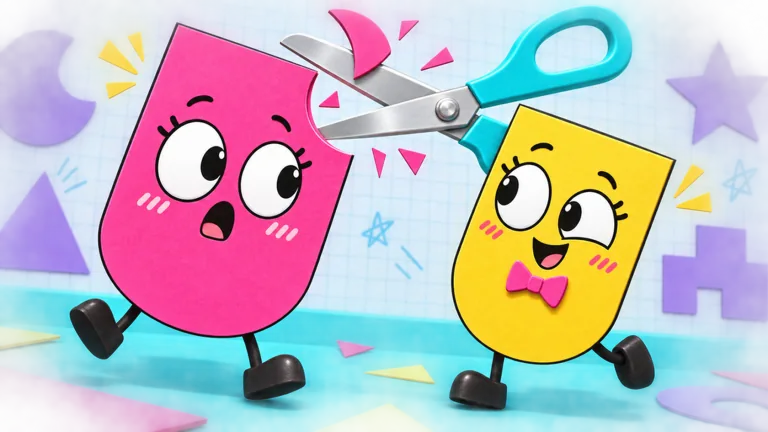
Do not treat the name as an instruction to use real baseball controls. This is a paper-character puzzle built around shape, positioning and cooperation. You need to prepare a crossing and an upward delivery.
Compare the starting ball height with the basket height before moving it. Pushing it across the floor alone will not get it into the high net.
Inspect the low opening and high destination
The tall purple divider separates the two sides. Its lower area is accessible to the standing characters, but the basket requires a separate height change after the crossing.
Before cutting, decide where the ball can rest on the destination side. Position one player to receive it while the other prepares the paper opening. A gap is useful only when the carrier and ball can follow the route it creates.
After a cut, pause and inspect what remains. A thin strip at the bottom or an awkward edge beside the gap can still interfere with the transfer.
Build a shape for the next job
Use a receiving recess to control the ball during the crossing. Rotate the supporting surface toward the ball and keep it stable while the partner moves into position.
For the high destination, think about support and delivery separately. A shape that holds the ball low needs a plan for reaching the net. Your partner’s position can help establish the next support or handoff, but that position should be prepared before you move the ball toward it.
- Inspect the divider, ball and basket together.
- Open an accessible route through the paper.
- Prepare a ball carrier and a receiving position.
- Move the ball through the opening deliberately.
- Set up the height change on the destination side.
- Check the ball against the net and completion display.
The exact cut and delivery depend on your current layout. Use the visible geometry instead of a memorized button sequence.
Change one part of a failed attempt
| Failure | Useful next check |
|---|---|
| Ball remains stuck at the divider | Opening width, height and leftover paper |
| Ball slips while crossing | Carrier orientation and the edge supporting it |
| Ball reaches the right side but stays too low | The planned support or handoff toward the high basket |
| Delivery passes beside the net | Final direction and position relative to the rim |
| Both players lose track of the ball | Pause movement and assign one receiver |
Keep a working opening intact while testing the delivery. Cutting more divider paper does not solve a miss that happens near the basket.
Likewise, preserve a useful carrier while adjusting the partner’s support position. Changing both bodies at once makes it difficult to learn whether the problem was holding the ball or reaching the destination.
Compare Baseballin’ with the other ball boards
Alley Oop includes a raised starting platform and a different basket arrangement. Bowling for Baskets changes the object route again. Carry over the habit of preparing a receiver, but recheck each board’s heights and obstructions.
The Baseballin’ chapter begins at 04:00. Use that chapter to identify this layout, not to assign a permanent official stage number.
FAQ
What is the Baseballin’ objective?
Open a route through purple paper and work together to score with the ball in the basket.
Why does getting past the divider not finish the puzzle?
The basket is elevated. You still need an upward delivery to its opening.
Does the game provide a baseball batting button here?
Check the inputs shown in your current HUD instead of assuming there is a separate batting button. Plan with character shapes and positioning.
Should I cut more paper after missing the basket?
Only if paper still blocks the intended route. A miss near the net calls for a delivery-position check instead.
Can I reuse the Alley Oop solution unchanged?
Check the current geometry. Baseballin’ has a different starting arrangement and basket height, so the transfer plan needs adjustment.