Read the goal before making your first cut
Start each board by deciding what the puzzle needs, then agree which partner will hold still and which will make the cut. Position and rotate first. Cut only when the overlap produces a useful shape, test that shape against the objective, and reform when you need a fresh starting body.
The mistake that stalls a new pair is treating every board as a race to remove paper. Sometimes the goal is to preserve an outline. Sometimes your body needs to carry an object. A percentage puzzle asks you to keep a specific amount of paper. The same aggressive cut can help one board and ruin the next.
Before cutting, ask what must remain and what must move.
Use a simple partner loop
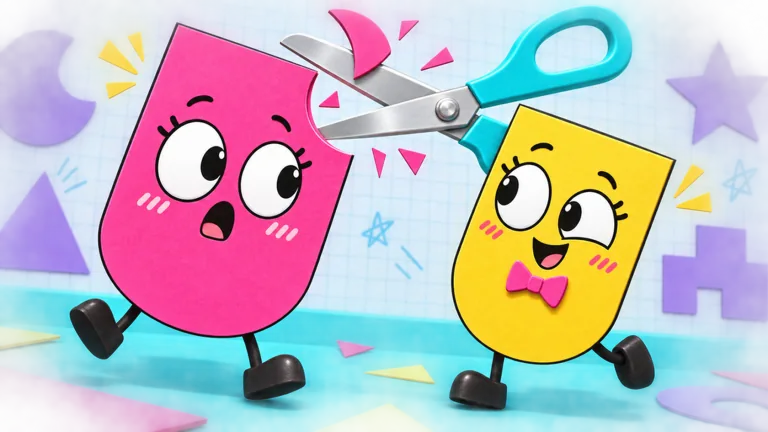
Your paper character is both a player and a tool. Its current shape determines the boundary it can cut into the other character and the surface it offers to a ball, firefly or partner.
- Read the instruction and find the destination, outline or meter.
- Choose a stationary receiver and a moving cutter.
- Place the characters where the intended cut will happen.
- Turn the cutting boundary toward the required edge.
- Make one deliberate cut, then separate to inspect it.
- Try the shape on the actual objective before trimming again.
Call out a short instruction such as “hold there” or “rotate once” before pressing cut. If both players move at once, it is harder to tell whether a bad result came from position, orientation or too much removed paper.
Match your approach to the board
| Board type | Your first decision | Common mistake |
|---|---|---|
| Shape Match | Can the full characters fit through positioning alone? | Cutting before trying rotation and overlap |
| Clean Sweep | Which purple regions remain untouched? | Revisiting the cleared middle while missing an edge |
| Make the Cut | Which dotted boundary must survive? | Removing the target along with the surrounding sheet |
| Half Measures | What band does each character’s meter require? | Assuming both partners need the same amount |
| Ball or firefly board | Where can the object rest during the next movement? | Moving the carrier without preparing a receiving surface |
Use the instruction visible on your current board. Puzzle layouts and navigation can change, so a familiar name is a better starting point than an assumed permanent level number.
Learn the controls that support precise teamwork
On PC, Q and E rotate, R reshapes, left mouse button snips, and Shift slows movement. Check the PC interface for Space to jump and right mouse button to reform. The official experience page lists R as the reshape binding.
Slow down for a final alignment. A small position correction is easier to judge when the receiver remains still. Reform restores a starting shape; treat it as a restart of that character’s geometry rather than a promise to undo one specific cut.
Keep a useful shape long enough to test it. Constantly reforming prevents your pair from learning why a scoop catches an object or why a slanted edge misses an outline.
Recover from a failed attempt
First identify the failure. If an outline nearly fits, adjust position and rotation before removing more material. If an object slips, inspect the opening or slope of the supporting shape. If a percentage meter is too low, additional cutting cannot restore the missing paper.
Reform the character that needs rebuilding, agree on the next cut, and repeat with one change at a time. Avoid changing both bodies and both positions together: even a successful attempt becomes difficult to repeat when neither player knows what fixed it.
For input details, open the controls guide. For the first fitting puzzles, use the Shape Match walkthrough.
FAQ
What do you do in Cut it Out?
Work with a partner to cut paper characters into useful shapes and solve the board’s current puzzle. The objective determines whether you fit an outline, remove paper or guide an object.
Should both players cut at the same time?
Take turns while learning a shape. One player holding still gives the other a clear cutting boundary and makes the result easier to diagnose.
Do you need to cut on every Shape Match board?
Try positioning full characters first. The initial fitting board can be approached without trimming, while later outlines require complementary shapes.
Is reforming the same as undoing the last cut?
Use reforming to restore a starting body. Do not rely on it as a selective undo that preserves every earlier change.
How do you know when a puzzle is finished?
Watch the current board’s objective and completion display. Outline gauges, balloon counters and separate percentage meters measure different tasks.