
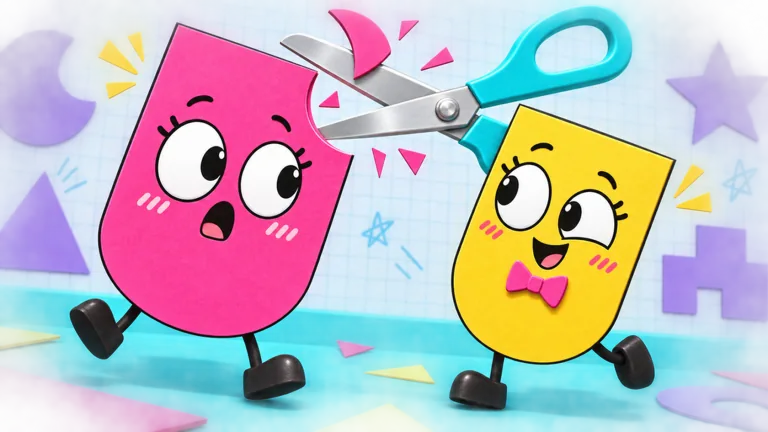
Build a crossing before guiding the hamster
Bridge the gap and prepare the route toward the hamster’s exit. Inspect the crossing surface before encouraging movement: a character standing on the far side does not help if the route between the two sides is still interrupted.
Look for the hamster on the left, the floor gap between sections and the exit toward the upper right. Connect the crossing first, then plan the final approach to the exit.
Build your Hamster Helper route around the next surface the hamster can reach.
Inspect the whole route from left to right
Identify the starting area, gap, receiving surface and exit. Compare their heights before cutting either character. A shape that spans part of the crossing still needs to connect usefully with the next surface.
Look for paper or a character body obstructing the intended path. Keep one partner out of the way while the other tests a support position. The hamster’s route matters more than whether both players can stand comfortably in the same area.
Decide which player handles the crossing and which prepares the destination side. Clear roles make it easier to preserve support while adjusting the next part.
Shape and position for support
A stable supporting edge is more useful here than a pointed tool. Rotate and place your body so its usable boundary contributes to the crossing. Inspect how it meets the fixed surfaces on either side.
If the current body offers an awkward slope or gap, reshape it with your partner. Make the cut while the receiver holds still, then test the new boundary in the intended position before changing the other body.
- Trace the hamster’s route to the next surface.
- Inspect the gap and the height of its far edge.
- Prepare a support shape and orientation.
- Position the destination-side partner.
- Check that the crossing has no obvious interruption.
- Guide the hamster onward while preserving the support.
Treat this as a geometry check. Do not rely on a single body angle to work on every version of the board.
Prepare the exit approach separately
After the gap, compare the hamster’s position with the exit and any intervening paper. The exit is above the initial floor level, so you still need to connect the remaining route after crossing.
Watch the board’s arrows, instruction and current moving pieces before adjusting the final approach. Prepare the next accessible surface, then observe where the hamster actually goes.
Keep the partner supporting a working section still while the other inspects the next one. Moving both characters after every small stall can dismantle a crossing that was already useful.
Find the point where the route breaks
| What stalls | First inspection |
|---|---|
| Hamster has not reached the gap | Starting path and any body blocking it |
| Crossing begins but fails at an edge | Connection between the support and fixed surface |
| Hamster reaches the far side but not the exit | Remaining height change and obstruction |
| Support shifts during movement | Which partner is moving or rotating |
| Shaped body no longer supports the route | Reform that character and rebuild deliberately |
Use slow movement for the final support adjustment. If a surface already works, preserve it while testing the next section. Change the route at the actual failure point instead of resetting every useful shape.
The Hamster Helper chapter begins at 05:29. For partner coordination fundamentals, see the beginner guide.
FAQ
What is the Hamster Helper goal?
Bridge the gap and guide the hamster to its exit. Check both the crossing and the route after it.
Should I make a pointed shape?
Prioritize the supporting surface the crossing needs. A point is useful on balloon boards, not automatically on a bridge task.
Why does reaching the other side not finish the puzzle?
The hamster still needs to reach the exit. Inspect the remaining height change and any obstruction.
What should my partner do while I adjust the bridge?
Prepare the receiving side or preserve an already working support. Avoid moving both parts of the route at once.
When should I reshape a character?
Reshape when its boundary cannot support the required route. First inspect whether a position or orientation correction would preserve the useful shape.